The Schools of Tippecanoe, Part 1: The Beginning
Part 1 of 3
By Mike Jackson
In 1840, an early settler in Miami County named John Clark saw the potential for a town at the intersection of the Miami and Erie Canal, completed in 1837, and the state road connecting Springfield and Greenville. He platted seventeen lots on land he owned. Clark named his new village Tippecanoe, the name based on the slogan “Tippecanoe and Tyler, too.” This was the campaign slogan of presidential candidate William Henry Harrison, a man Clark greatly admired. Around 1850, citizens began to call their town Tippecanoe City to avoid confusion with another Ohio town also named Tippecanoe. The name remained for nearly ninety years.
Even before 1853, when the state of Ohio first required communities to provide schools for their children, the citizens of Tippecanoe and Hyattsville valued education and established schools for their children. Pre-1853 schools in Hyattsville and Tippecanoe were located in various locations. In 1832, a log school known as Township District No. 2 School was located near the intersection of what are now Rohrer Drive and Main Street and served both Hyattsville and Tippecanoe.
By 1841, enrollment had increased enough that a separate school was needed for the Tippecanoe students. A 20 by 24 foot, one-room school called District No. 9 School was placed “in the bottoms,” east of the canal on the north side of the state road, now called State Route 571. The children in Hyattsville continued to attend District No. 2 School. As the population of Tippecanoe grew, the No. 9 School soon became too small, and a new school for Tippecanoe was built on North First Street near Plum Street.
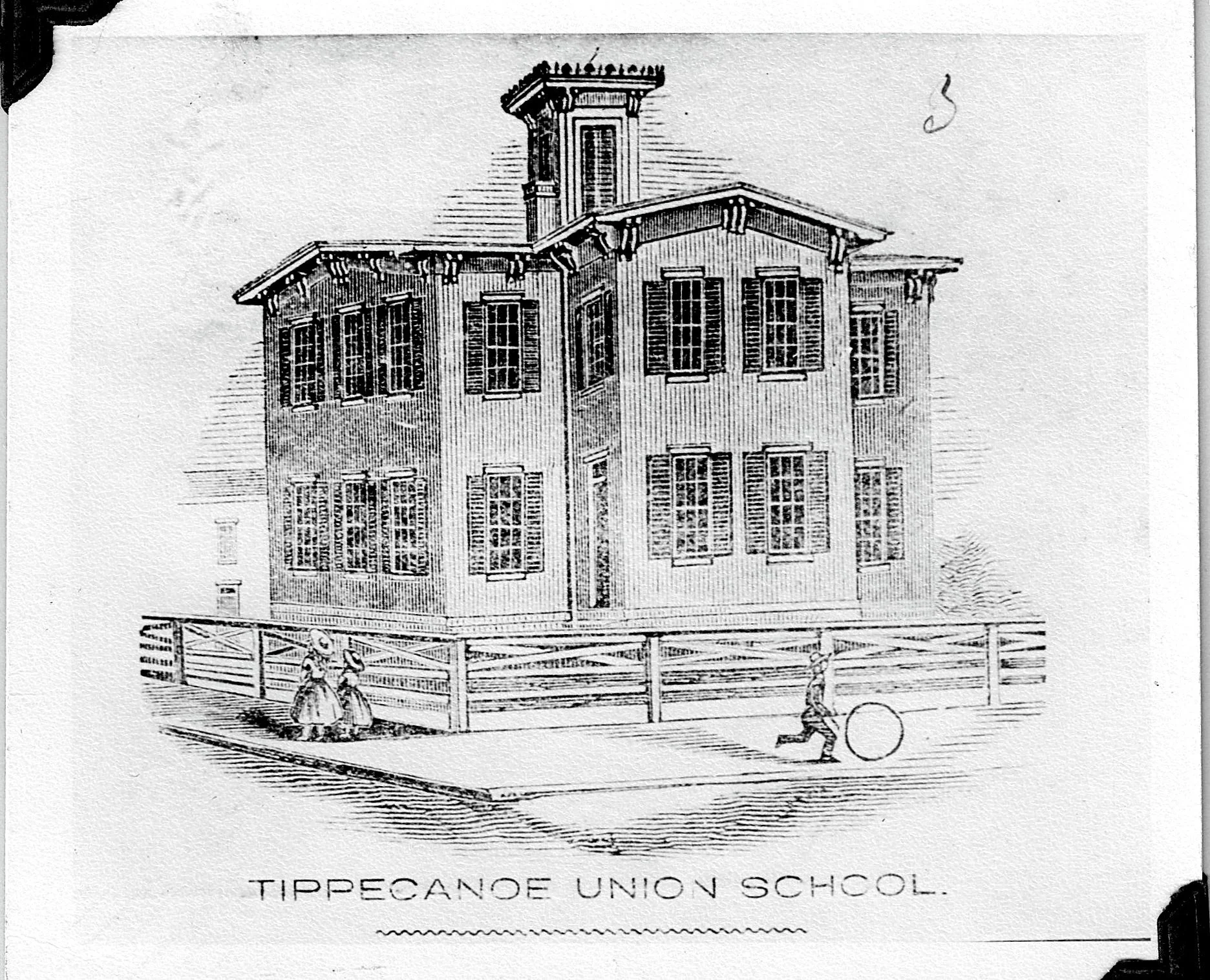
After the state of Ohio passed legislation in 1853 requiring all communities to provide schooling for their children, a school board was formed, and a new, brick building, the Tippecanoe Union School, was constructed on Dow Street between Third and Fourth Streets and opened to students in September 1854.
With Tippecanoe’s population continuing to rapidly grow, within only a few years, classes had overflowed into woodsheds and surrounding buildings. To alleviate overcrowding, the present Dow Street school campus, bounded by Broadway, Dow, Fifth, and Seventh Streets, was purchased in 1868, and a three-story brick building was built and opened in September 1869.
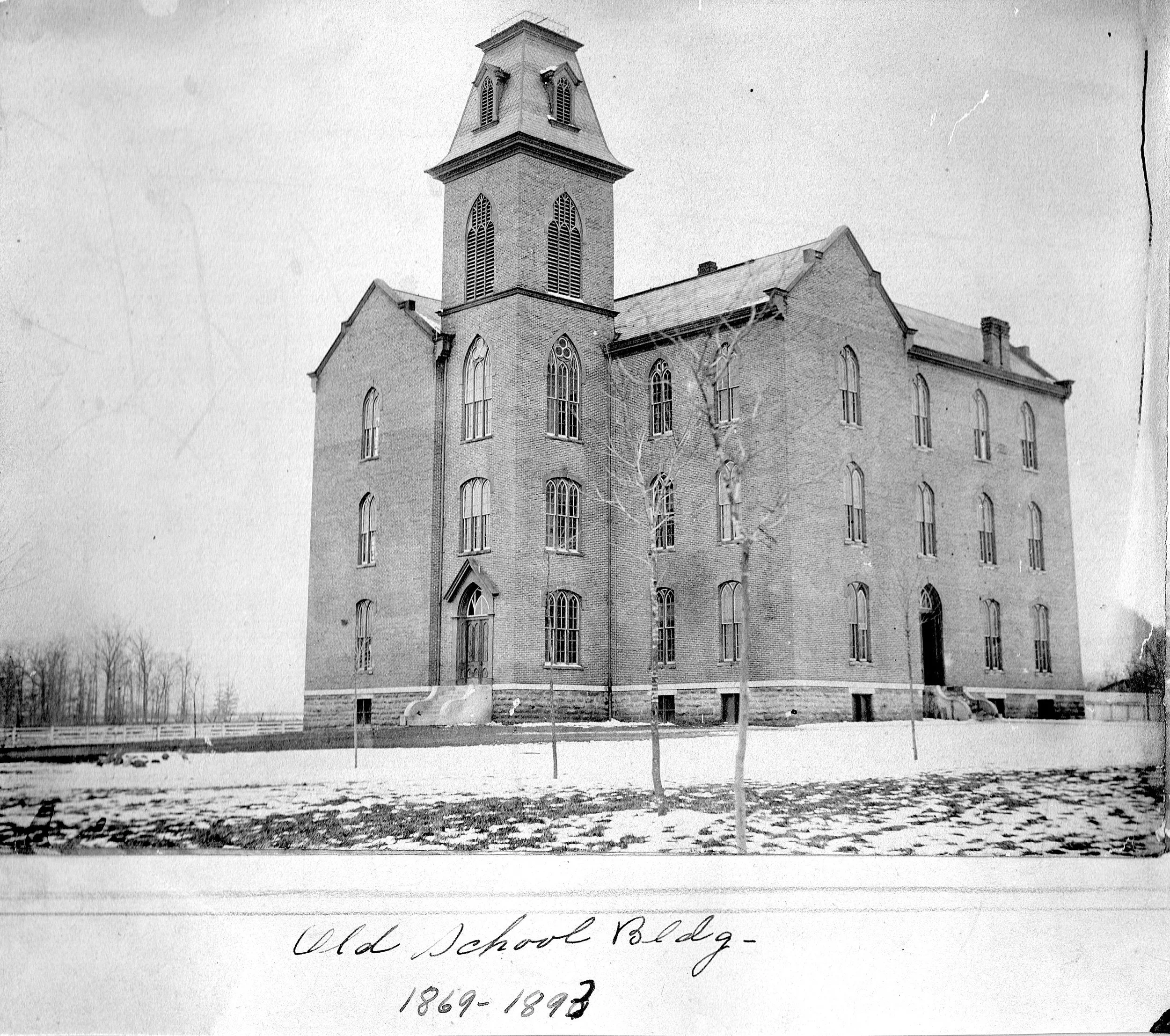
This building was impressive, especially for this period only four years after the Civil War. It was three stories high and had twelve rooms, two stairways, a high tower, and two coal furnaces in the basement during a time when many homes were heated by fireplaces.
The Tippecanoe Union School on Dow between Third and Fourth Streets was no longer needed as a school and was torn down in 1870, replaced with three wooden homes at 6, 10, and 14 West Dow Streets. Interestingly, the school’s bricks were reused to build three small brick homes for three prominent citizens. The homes were built on Dow Street (20, 26 and 30 West Dow) and those homes are still in use today.
In 1874, the citizens of Hyattsville asked to be incorporated into the village of Tippecanoe so that they could have better schools and other benefits of a larger town.
While education was important to Tippecanoe, very few people had the resources to complete twelve years of formal schooling in the early and mid-1800s. Men were expected to obtain jobs in business, manufacturing, or farming. Women were expected to help in the household, and many began their own families at an early age.
It wasn’t until 1878 that the first class graduated from Tippecanoe High School. The Class of 1878 consisted of four graduates, three girls and one boy. The graduation of Tippecanoe’s first class was a cause for celebration throughout the town, complete with a parade, a brass band, and picnics. The graduation was held in the evening at the Chaffee Building and, according to accounts, the street in front of the Chaffee Building was crowded two hours before the graduation program started.
The Tippecanoe school building, which opened in 1869, was advanced for its time but hadn’t been well-constructed and was condemned in 1893. From 1893 until 1894, classes were held in sheds near the building, which were referred to as the Ramrod Academy.
By September 1894, a new building had been constructed on the site of the 1869 building. This building, housing first through twelfth grades, had twelve rooms and was used until 1966. Many residents remember this beautiful building as the “Castle.”
(Next week, “The Castle”)
I acknowledge and thank the Tippecanoe Historical Society and the editors of the Sesquicentennial History of Tippecanoe and the Tippecanoe High School yearbooks for some of the information used in this series of articles.
Interested in becoming a Site Sponsor? Your ad will run at the bottom of EVERY NEWS STORY. Click HERE for more details.