
Troy Historical Society receives money to restore Overfield Tavern
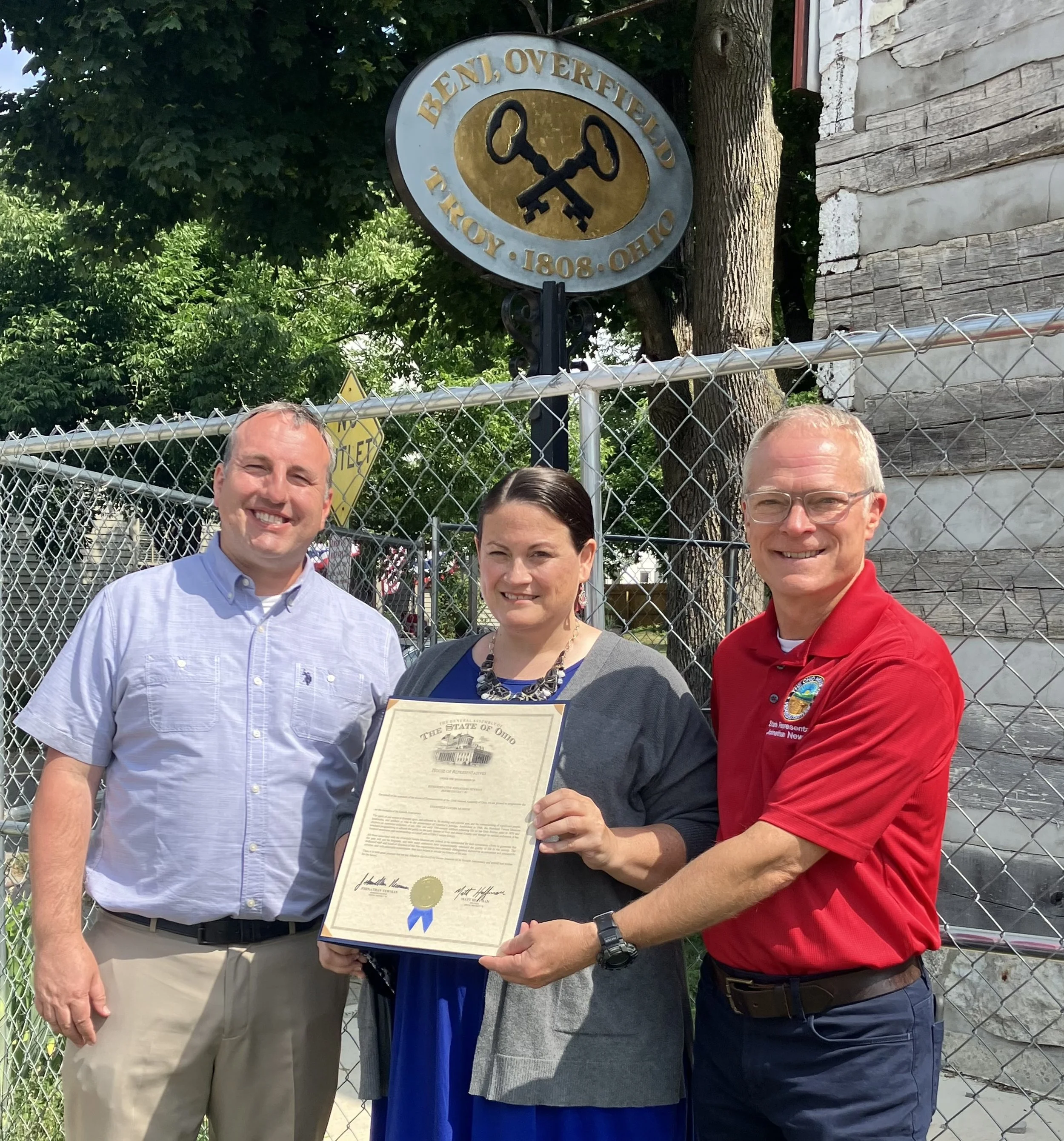
Troy Historical Society receives $275,000 state investment to restore Overfield Tavern
The Troy Historical Society has been awarded $275,000 in state funding to support the restoration of the historic 1808 Overfield Tavern, Troy’s oldest surviving building. The funding was secured through Senate Bill 450, Ohio's $3.7 billion capital improvements budget for fiscal years 2027–2028, signed into law by Governor Mike DeWine. The investment marks a major milestone in the restoration of the two-story log tavern, which was severely damaged by fire in December 2024.
The state appropriation builds upon the $75,000 in emergency assistance previously provided by the City of Troy for environmental cleanup and stabilization following the fire. Additional support has come from The Troy Foundation, The Dayton Foundation, the Jeffris Family Foundation, the Hartzell Charitable Trust, the Miami County Visitors & Convention Bureau, and the National Trust for Historic Preservation.
Recently, the General Assembly of the State of Ohio House of Representatives, under the sponsorship of Representative Johnathan Newman (House District 80), presented a proclamation recognizing the 60th anniversary of the Overfield Tavern Museum for six decades of preserving and sharing the stories of Troy's frontier past. Both Newman and State Senator Steve Huffman supported the capital funding to help restore the museum.
"The restoration of the Overfield Tavern is about preserving an irreplaceable piece of Ohio's frontier history," said M. Chris Manning, Executive Director of The Troy Historical Society. "This funding brings us one step closer to reopening Troy's oldest building and original gathering place, ensuring that future generations can experience the community's earliest history firsthand."
Troy's Original Gathering Place
Benjamin and Margaret Overfield arrived from Pennsylvania in 1803, the year Ohio became a state. After Miami County was created in 1807 and Troy was selected as the new county seat, Benjamin Overfield purchased a lot in the newly platted village and constructed a substantial two-story log building on the corner of East Water and North Mulberry streets.
On September 13, 1808, Overfield received a license to operate a tavern. Less than two months later, the Court of Common Pleas began meeting in the building until a permanent courthouse could be constructed in the Public Square. In addition to serving as a home, tavern, inn, and courthouse, the building became the center of community life. Public auctions, business meetings, elections, and countless civic gatherings were held there, earning the tavern its reputation as Troy's original gathering place.
In 1824, Benjamin Overfield moved his tavern business to the northwest corner of the Public Square, closer to the newly completed brick courthouse. His original log tavern on East Water Street became a private residence and was covered with siding, preserving its historic fabric even as its historical significance faded from public memory.
A Legacy of Preservation
The tavern's modern history began in the late 1940s when the Hobart Brothers Company purchased the property. The company removed modern finishes and materials in an effort to restore the building to its early nineteenth-century appearance. Following the initial restoration, the tavern remained closed to the public and was used for Hobart family and company functions. In 1960, Julia Hobart, wife of William H. Hobart, founded the Overfield Nursery School, which occupied several rooms in the rear of the building.
In 1965, the Troy Historical Society was founded, and the following year the Overfield Tavern Museum officially opened to the public. Although the Hobart Brothers Company retained ownership of the property, the historical society assumed responsibility for operating the museum. Virginia Boese became the museum's first curator, assembling period furnishings and artifacts while conducting extensive research on the Overfield family in archives and cemeteries throughout Ohio and Pennsylvania. Her work established the historical foundation that continues to guide interpretation of the site today.
When the Overfield Nursery School relocated in 1989, the museum expanded into the former classroom space, allowing its growing collection of artifacts to be displayed throughout the building.
A Community Landmark
Another major restoration effort began in 1993 when Robert Patton became director of the Overfield Tavern Museum. Working with assistant curator Busser Howell, a member of the extended Hobart family, Patton led a multi-year effort to restore the building to its early nineteenth-century appearance.
During that restoration, Illinois Tool Works (ITW) acquired Hobart Brothers Company. As the company divested properties unrelated to its business operations, the museum lost the financial support that Hobart Brothers Company had long provided for maintaining the historic building. At the time, the Troy Historical Society did not have the resources to maintain the building itself. In response, the Overfield Tavern Museum incorporated as a separate nonprofit organization in December 1995 and launched a community campaign to support its operations and the building’s restoration and long-term preservation. Ownership of the property was formally transferred to the museum in 1997, ensuring that the landmark would remain under local stewardship.
Looking Ahead
Although the December 2024 fire was one of the greatest challenges in the museum's history, it also created an unprecedented opportunity. In October 2025, archaeologists uncovered more than 18,500 artifacts beneath the building and in the backyard, including coins, ceramics, animal bones, and other objects that deepen our understanding of daily life on the Ohio frontier. Dendrochronology, also known as tree-ring dating, helped verify the log building’s 1808 date of construction.
Earlier this year, the Overfield Tavern Museum and the Museum of Troy History merged with The Troy Historical Society to create a stronger organization dedicated to preserving and interpreting Troy's history. Planning for the restoration of the Overfield Tavern is well underway, with construction expected to begin in late 2027 as additional funding is secured.
Monday's announcement coincided with another important milestone. The General Assembly of the State of Ohio House of Representatives, under the sponsorship of Representative Johnathan Newman (House District 80), presented a proclamation recognizing the 60th anniversary of the Overfield Tavern Museum for six decades of preserving and sharing the stories of Troy's frontier past.
With state support, local partnerships, and continued community investment, The Troy Historical Society is committed to restoring one of Ohio's most significant frontier landmarks so that the Overfield Tavern can continue to tell the story of the community's earliest years for generations to come.
About The Troy Historical Society
Founded in 1965, The Troy Historical Society preserves and shares the history of Troy and Miami County through the Overfield Tavern Museum, the Museum of Troy History, educational programming, exhibitions, publications, and community events. The Society is dedicated to preserving the region's historic places and inspiring future generations through local history.
For additional information about the restoration project or opportunities to support the restoration of the Overfield Tavern, please contact the executive director of The Troy Historical Society at mchrismanning@gmail.com.
Interested in becoming a Site Sponsor? Your ad will run at the bottom of EVERY NEWS STORY. Click HERE for more details.