If Tombstones Could Talk
The storms stayed away, and the 2026 Annual If Tombstones Could Talk was held on June 7.
As part of America’s 250th birthday, historical presentations about forebears with ties to the Revolutionary War were delivered. This annual event is held at the Maple Hill Cemetery, and the guests “featured” this year were Luther and Rebecca Chaffee, Abraham Favorite, David Sheets, John Retter, and John Murray.
This walk is sponsored by the Tippecanoe Historical Society and made possible by the Monroe Township trustees, who provided information and prepared the cemetery for the event.
Following is a transcript of the recorded speeches:
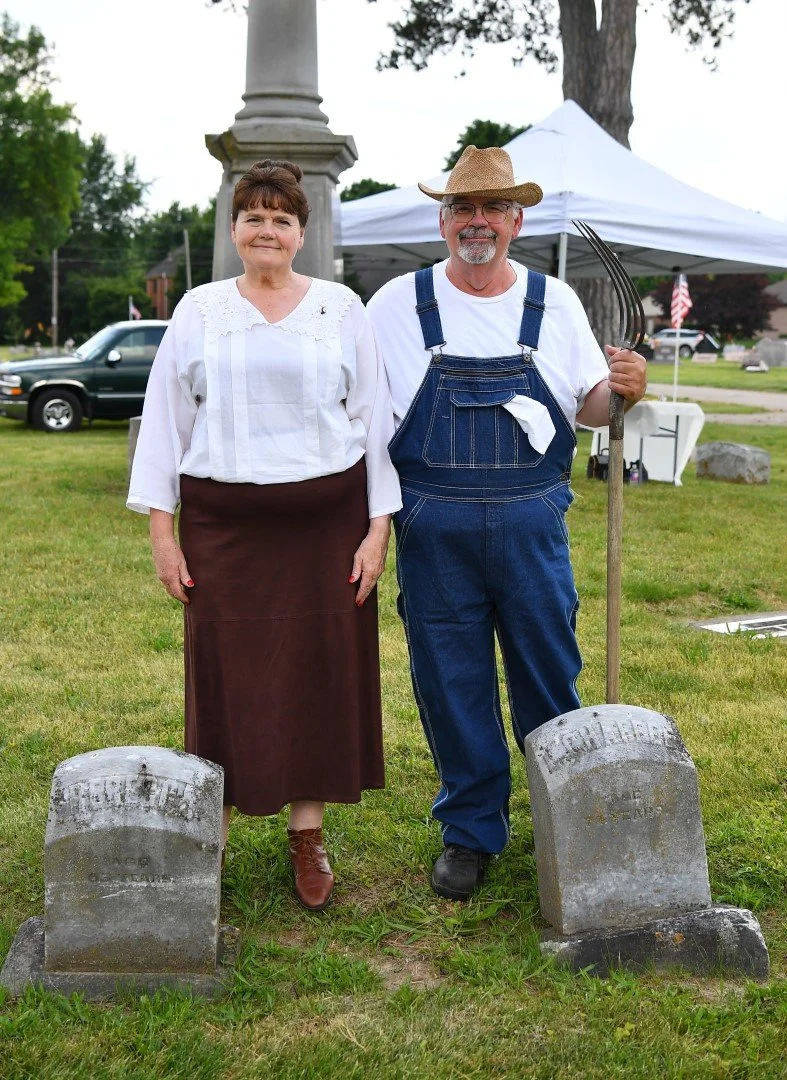
Luther and Rebecca Chaffee
Portrayed by Jeff and Annette Calicoat
“Hello, my name is Luther Chaffee, and in this grandiose section of the cemetery are my family's 32 graves. I was born in 1782 in Union Wyndham, Connecticut Colony, British Colonial America. Our address was more complicated before the Revolutionary War. My father was Darius Chaffee, and was born in July 24, 1751, in Connecticut Colony.
His father, my grandpa, Joseph, was 21 when my father was born, and my grandmother, Esther, was only 17. My dad, Darius, married his cousin, Molly Chafee, on November 11, 1775, in Winderbam, Hamden, Massachusetts. I had two brothers and three sisters.
My ties to the Revolutionary War are through my father, Darius. He enlisted on September 5, 1778, and was discharged 30 days later.
Having marched north, he also served as a Private in Captain William Fletcher's Company and Colonel Simmons's Regiment in Massachusetts in October 1780. He served for only six days, this time in the March to Paulette.
In 1782, Dad bought 100 acres of land in Union, Connecticut, and farmed it. He died on April 2, 1808, at the age of 56. My mom, Molly, survived dad, and records say she died in a fit.
The year that dad died, I married Rebecca Perkins. After we married in Connecticut, we moved to New York, then to Pennsylvania, back to New York, and then here to Ohio. I made my living as a tanner and a shoemaker, and also a farmer. I didn't have time for much else, but I did become a member of the Masonic Order.
I, Rebecca, was born on January 8, 1789, in Saratoga, New York, United States. My father, Christopher Perkins Sr., was 30, and my mother, Rebecca Palmer, was 32. As you can see, I was named after my mom.
My dad was born in Rhode Island, and he married my mom in Providence, Rhode Island, in 1776. When he was about 20, he bought a farm. I had 10 siblings. My connection to the Revolutionary War is through my father, who served as a Private in Colonel Cornelius Van Vechten's 13th Regiment of the New York Militia. He also served under Colonel John McCrae of the Albany County Militia in New York.
I carried on my family's tradition of having a big family. I got pregnant the year after we were married, and I had 13 children in the next 25 years. I had nine sons and four daughters.
The firstborn was Sidney Harvey, who lived to be two. My next son, Harvey Palmer, didn’t make it to his first birthday. My twin girls, Harriet Matilda and Harriet Mary, both died the same year when they were 37 years old. Then I bore Christopher Samuel, who only lived to age 27, and Sarah Mariah, who died at age 36. In 1819, I gave birth to another boy whom I also named Sidney in honor of my first child. This was Sidney Larkin Chaffee, and he's the most influential and best known child of Tippecanoe City because he built the Chaffee Opera House. He lived on to be 79 years old. Then came Joseph Henry and Perry Filinder. He was my longest-lived offspring, living to the age of 86.
My last girl was another namesake, Rebecca Lucretia. She died at only 25. My next son was John Edwin, and he lived a long 80-year life. And then came William Morgan, who lived to be 41. My last was Hyland Daniel, who died at 34.
I died on September 3, 1852, at the age of 63. We were living in Tippecanoe, Miami County, Ohio, and I was buried here in the Maple Hill Cemetery. My Luther lived four years after my death. He died on September 14, 1856, at the age of 74, and he also was buried here.
Luther lived long enough to see his son Sidney Larkin Chaffee purchase a two-story brick building in 1852. It was located at the southwest corner of 2nd and Main Streets in Tippecanoe City. In 1867, he extended the building by adding four storerooms to the west along Main Street and three smaller rooms to the south along 2nd Street. He then added a third and fourth floor over the original building.
He also added a second and third floor over the Main Street section, which became the Opera House and was known then as Chafee's Hall. It seated 600 to 800 people. And Tippecanoe's community numbered fewer than 1,000 people.
Over time the building has been used by many organizations for many events and much of it is still in use today. We are very proud of our son's legacy. “
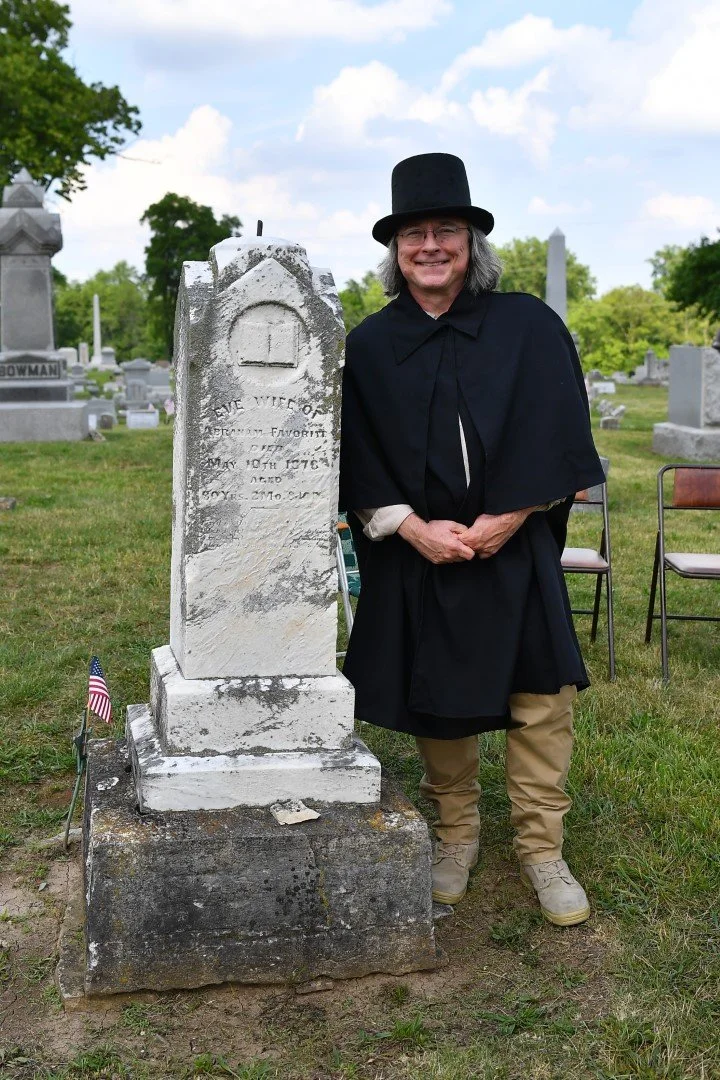
Abraham Favorite
Portrayed by Ed Merta
Abraham was born in 1786 in Frederick County, Maryland. He was the son of Heinrich Favorite and Sarah Burkes Favorite. It is known that Sarah was born in England, so Heinrich may have been as well, although the records don't tell. They were both born in 1750, and they got married when they were 15. They found their way to Frederick County, Maryland.
Heinrich and Sarah had eight sons and three daughters. One of the sons is Abraham Favorite. He grew up on a farm in Frederick County, Maryland, which is just west of what is now Baltimore and Washington, D.C.
1807, when Abraham was twenty-one, he married 19-year-old Elizabeth Shrioch. They were married in Frederick County, but by 1812, we know they had moved to Miami County. Abraham was a member of the 2nd Regiment of the Militia that was attached to Miami County.
So they were farmers, which sounds simple enough, but back then farming meant something different to folks like Abraham and his wife Elizabeth.
From around 1807 to 1812, Ohio was mostly forested. The first order of business for farmers was to chop down the trees. They would eventually use some of the lumber to construct a log cabin with a dirt floor and a fireplace. They would have built fences around their property, usually 10 to 50 acres for farmers like this. One of their duties would have been to hunt down the wildlife and try to clear it out so it wouldn't come after their crops later. At the time in Ohio, there was a state law requiring men between the ages of 18 and 45 to certify once per year to the state that they had killed 100 squirrels. Records were not found of whether Abraham met his quota, but presumably he did.
So that was normal life back then, working with an iron-bladed plow drawn by an ox or a horse- hard work. The normal routine of that life was interrupted as the War of 1812 broke out.
By law, if called up, you had to serve six months, and you were done. Abraham enlisted on February 22nd, served until August 21, 1813, and was then discharged. Abraham returned to his life as a farmer.
In 1825, his wife Elizabeth died at the age of 37. Abraham was 39. He remarried in 1827. His second wife, Eve Long, is buried with him in Maple Hill.
Eve was born in Green County, Ohio, and was a member of a prominent pioneer family and one of many children. Three of her brothers served as ministers.
Abraham, by his first wife, had three sons and two daughters who survived to adulthood. With Eve, they had three sons and three daughters. Abraham died in 1848 at the age of 61.
Through two marriages, he had many grandsons and granddaughters, and the name Favorite became very common in this area. The Favorites were very active in commerce, business, and farming around this area. One example: Henry J. Favorite founded the Favorite Insurance Company in 1896.
It lasted through the 20th century, eventually passed to new ownership out of the family, but it retained the Favorite name and carried on the Favorite legacy before being bought by another firm in 2013.
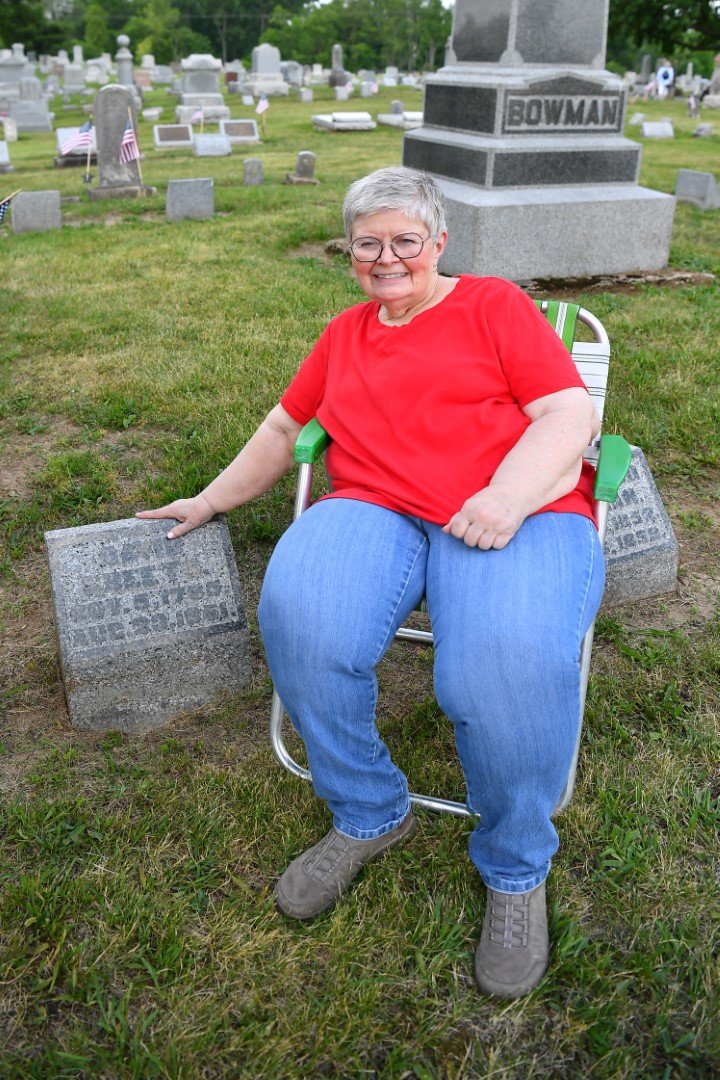
David Sheets
Presented by Jackie Wahl
There are four graves in Maple Hill with the name Sheets: David, Thomas, Allie Crane Sheets, and Lewis Sheets.
But we want to talk about Johan Martin Sheets first. He was born in Germany in 1735. He arrived in Philadelphia in 1753 at the age of 18. Johan, soon to be known as John, married Margaret Lizabeth Snyder. They had eleven children.
John’s connection to the Revolutionary War was that he enlisted in what was known as Sharp's Company in North Carolina in 1782. His enlistment was supposed to last 18 months, but he was said to have deserted on June 23rd, 1783. He died in Miami County in 1810.
John’s fifth son, David, was born in North Carolina in 1785. He moved to Monroe Township in Miami County in 1850. He married Rebecca Mast in August of 1807 in Montgomery County.
He died in August of 1851 and was buried at Hyattsville Cemetery. But it is assumed that his remains had been moved to Maple Hill since there's a marker here with his name on it.
Thomas Sheets was born in 1841 in Maryland. He was a millwright and came to Tippecanoe to help build the mill by the canal. No connection could be found between Thomas and David. It is suspected Thomas was either a cousin or nephew.
Thomas married Allie Crane, who is buried next to him.
Thomas was considered a good businessman. He was also an assistant director of the Hook and Ladder Company, which is the fire department, in 1872.
Then the fourth grave is Lewis, who is the son of Thomas. He was born in 1869. After public school in Tippecanoe, he attended Eastman's Business College in New York. He was quite the businessman himself. In 1895, he was elected trial justice of peace. In 1896, he was elected to his first of many terms as mayor of Tippecanoe.
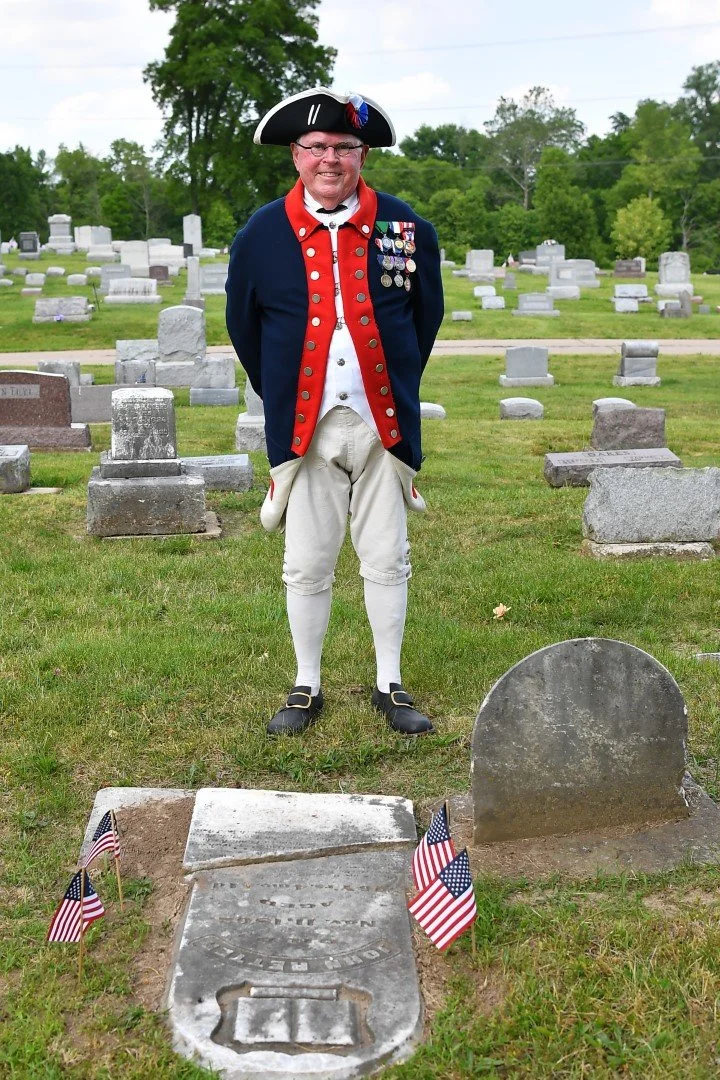
John Retter
Portrayed by Lee Emrick
John Ritter was born on July 10, 1786, in Maryland, and he was one of eleven children. His father's name was Tobias, and his mother's name was Eva Catherine Yakley. John married Sophia Fair on August 13, 1820, in Miami County. No records of children could be found.
After arriving in Ohio in 1820 and after his marriage, he received title to Sophia's land, which had been a 1812 land grant to Sophia's father, Michael Fair, for land “West of the Great Miami,” issued by the U.S. Department of the Interior's Bureau of Land Management. This may have been a benefit for her father's military service during the Revolutionary War, although no record of such service has been found.
Father Tobias Retter also received a land grant for land “Between the Miamis” and settled in Beavercreek Township in Greene County, Ohio. He's buried in Beavercreek Township Cemetery, and three of his children are buried in the Beavercreek Aly Cemetery.
Miami County tax records for 1829 showed that John Redder owned 160 acres and paid $14.32 in property taxes to the county, township, school, state, and the canal.
1860 federal census for the Non-Population Schedule showed the following for John Retter:
100 acres improved and 60 acres unimproved
Grew wheat, Indian corn, and oats
Livestock: five horses, four milk cows, two other cows, and eight hogs
Total cash value was $5,600 for land and $300 for livestock
John Retter died on November 11, 1862, in Evanston and is buried here in Maple Hill Cemetery. Evanston was the area at Evanston Rd. and County Rd. 25A. Probate Record of Last Will in 1862 showed he bequeathed the south half of Section 21 and additional cash to the Lutheran Church parsonage.
There are 19 Retter graves in Maple Hill. The last one is for Adell Retter who was buried in 2002.
Tobias Retter (John’s father) was born January 15, 1761, possibly in Germany.
Tobias fought in Maryland from 1775 to 1784 in the Fifth Regiment during the Revolutionary War. He also fought in Massachusetts in 1781. He died in Green County on June 4, 1824, and is buried in Beavercreek Cemetery.
John's wife, Sophia, was born July 12, 1796, in Frederick, Maryland. She was one of four children. She married John Retter August 13, 1820, in Miami County. Sophia died October 19, 1874, in Evanston, Monroe Township, at the age of 78.
Sophia’s father, Michael Fair, was born in 1750 in Maryland to Maria Barbara Euchlin Fehr, age 13, and Johan Christofel Fehr, age 20. Michael died November 13, 1809, in Miami, Ohio, at the age of 59. Upon his death, he left one quarter of Section 27 to his five children, including Sophia. This is the land on the southeast corner of Evanston Rd. and County Road 25A. It was recorded as a land grant in 1812.
John Murray
Portrayed by Joe Bellas
John Murray was born in what is now Pennsylvania, near a town called Somerset, Pennsylvania. At that time there was no town called Somerset; it was just empty farmland.
It is believed that John was born around 1780. We don't know exactly because there is no record, but we can backdate when he paid taxes and when he appeared in censuses. Now think about American history: you know in 1780 we were fighting for independence in the Revolutionary War.
And a little-known fact about John Murray’s father was that he was fighting in that war. His father's name was Daniel Murray, but Daniel Murray was not fighting for American independence. He was a British soldier born in Scotland. Daniel Murray came here as part of the British Army to fight against the United States.
At some point in the war, nobody seems to know when, Daniel Murray ran away from the British Army. He decided he wanted to fight for the winning side. And so he became an American at some point in the war. When the war ended, Daniel Murray bought some land in Pennsylvania and settled down as a farmer, where he married and had five children, John being the second-oldest of them.
Still living in Pennsylvania, John at some point met, fell in love with, and married Elizabeth Welbaum. They were married for about nine years and decided around 1810 to leave Pennsylvania. They traveled to Ohio by keelboat and bought property.
Son Sam wrote a journal as an adult and reminisced about his trip from Pennsylvania to Ohio. Samuel said that on the keelboat, they were very crowded. They had their cow, along with a whole bunch of people crammed onto this boat. The boat went very slowly and got stuck on lots and lots of sandbars. Samuel also remembered traveling down this river and the keelboat boatmen using very foul language. John did not appreciate the language, and several times told the boatmen to clean it up.
So finally, they got down to Cincinnati. When they got to Cincinnati, they unloaded into a wagon, and they traveled north to Montgomery County. Dayton existed at that time. Ohio had become a state in 1803. The Murrays decided to settle west of what is now known as Trotwood in 1811.
John Murray was a very skilled carpenter. He built his own cabin on his property, using trees from his land.
But in 1811, the Battle of Tippecanoe, where the United States attacked an Indian village, took place in Indiana. After that battle, the native Americans ran wild across the frontier. They figured that all the previous treaties they had signed with the U.S. government, including the Treaty of Greenville, which cleared out this whole area for white settlement, were null and void, and so they went on the attack.
John Murray and his family were very afraid, as they were there on their own, twelve hours from their nearest neighbor. Knowing it was safe, they moved to a fort about 10 miles away. Only at the fort for a week, John decided he was going to join the Army. At age 32, he signed up for the Ohio militia. He left the war at age 34 and returned to his cabin, which had not been touched by any Indian raiding parties.
In 1820, at age 40, John passed away. His wife Elizabeth lived for 30 more years as a widow.
Because women could not vote or legally own property, and there were no children old enough to inherit the land, John’s father, Daniel Murray, took ownership of the land. This is the arrangement Elizabeth and Daniel lived under.
According to the 1850 census, Daniel passed away between 1840 and 1850.
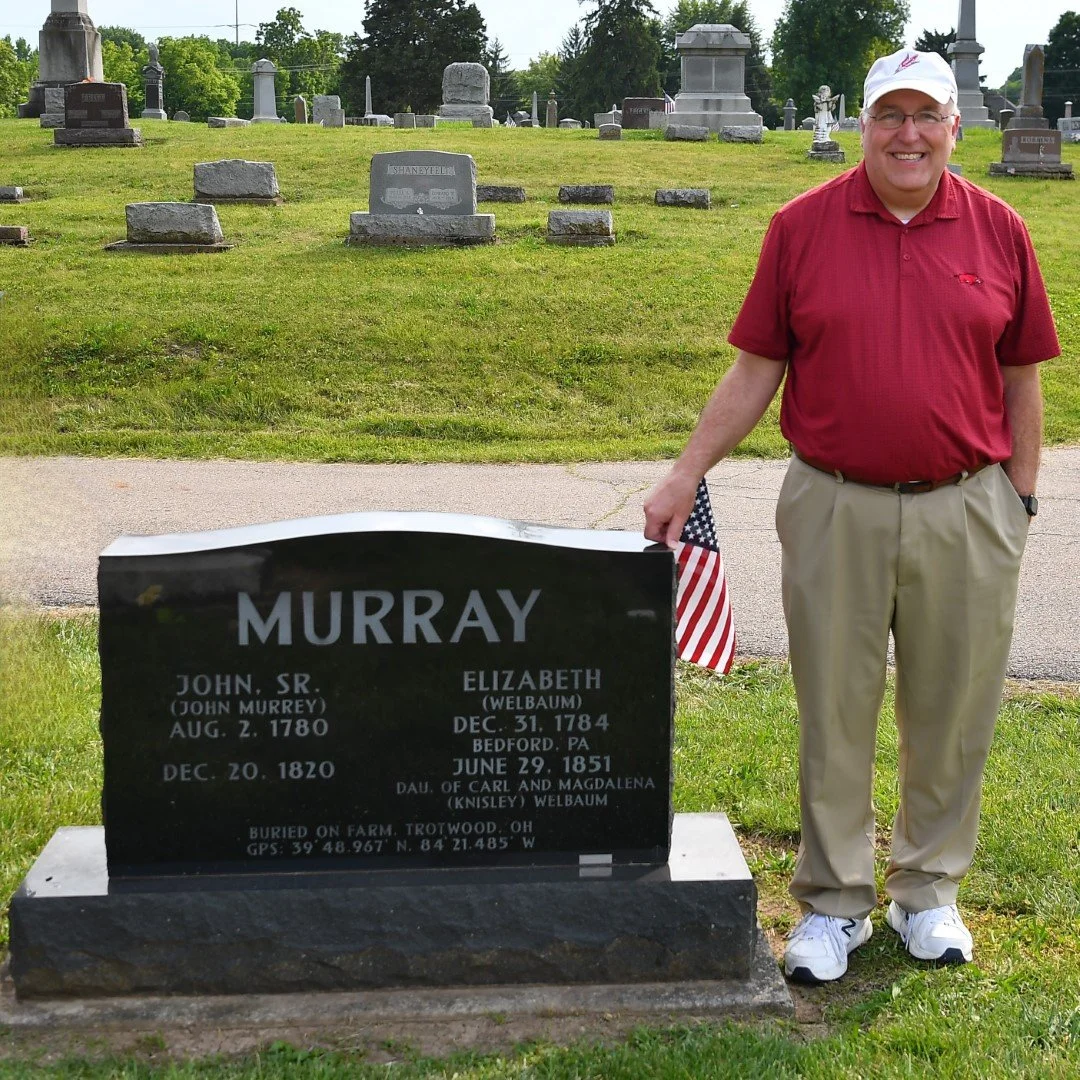
When the Murrays passed away, they had a family cemetery near their farm. This is where John, Elizabeth, and the patriarch Daniel are buried. In 2010, the great-great-great-great-grandson of John Murray, Gary Welbaum, decided to place a tombstone as a memorial to John and Elizabeth Murray. They still rest in peace in their family cemetery.
Interested in becoming a Site Sponsor? Your ad will run at the bottom of EVERY NEWS STORY. Click HERE for more details.