Downtime - “RoboCop” (1987) Review
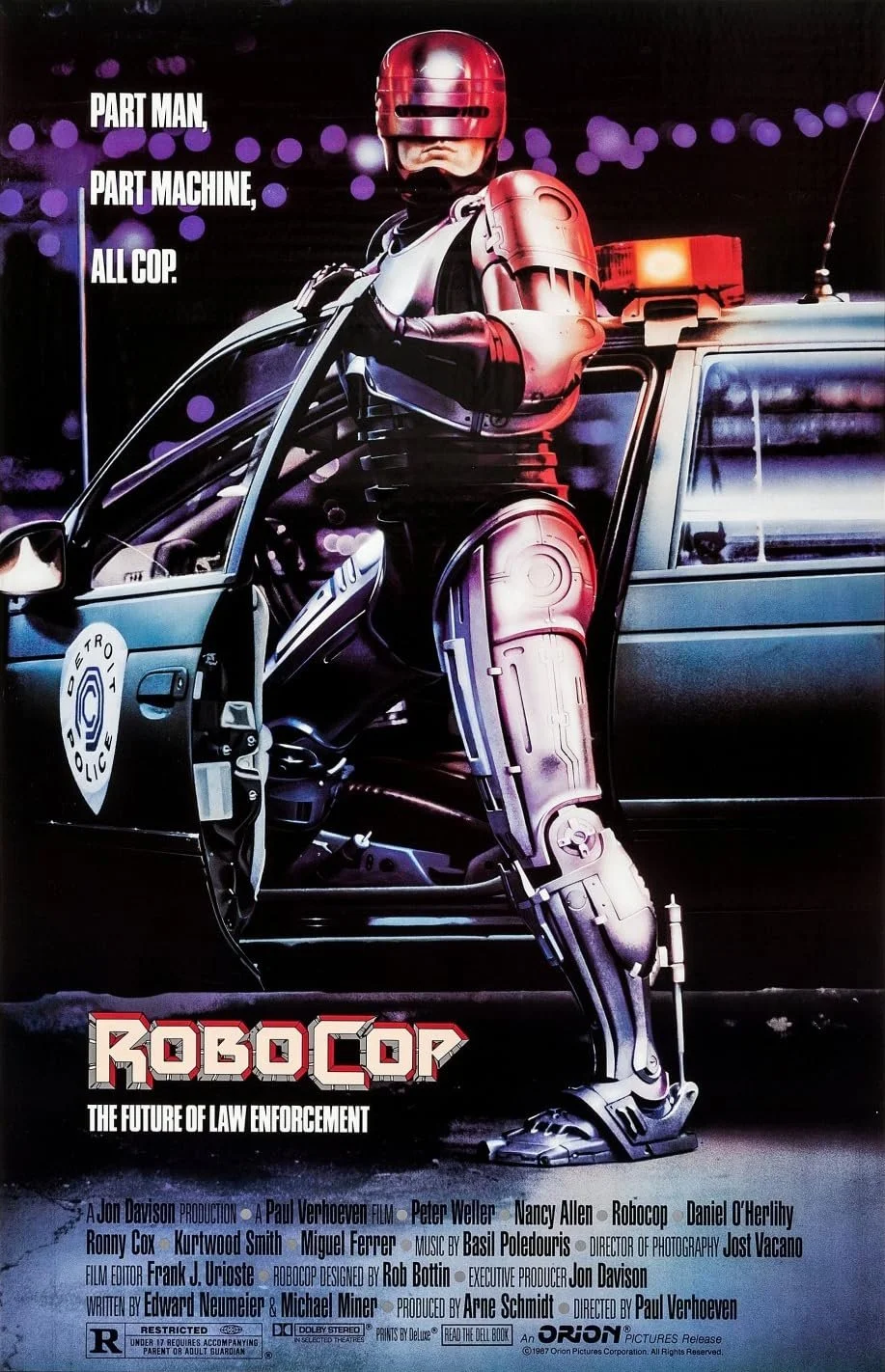
My wife and I are finally catching up on a slate of science‑fiction classics—the films that have defined the genre over the last half‑century. After some spirited debate over what to watch first, we struck a truce: we’ll take turns choosing titles from a couple of “must‑see” lists we dug up online. As part of the fun, I’ll be filing short reviews for the paper along the way. I invite you to come along as we dive into some of the finest science‑fiction movies ever made—and, inevitably, a few glorious misfires.
---
First up is Robocop, a dystopian classic from 1987. “I’d buy that for a dollar!” Set in a crumbling near‑future Detroit, “RoboCop” imagines a city so hollowed out by crime and economic decay that its leaders have recently contracted out all of their law enforcement to a private conglomerate known as Omni Consumer Products. The police force works for OCP, a corporation less interested in public safety than in contracts, real‑estate schemes, and weapons platforms—and seems to have little real interest in making the streets of Detroit a safer place to live.
Alex Murphy, a street cop newly transferred to a rough precinct, is ambushed and brutally killed by a sadistic crime boss and his crew. But that’s not the end of his story—instead, Murphy’s remains are quietly repurposed as the core of OCP’s latest experiment: RoboCop, an armed and heavily armored cyborg programmed with three priorities: to serve the public trust, protect the innocent, and uphold the law. Apparently, OCP is angling to completely replace the police force with cyborgs, echoing current-day concerns of people’s livelihoods being replaced with AI.
As an action film, “RoboCop” still holds up – and still has real punch. The shootouts are staged with grimy energy. Early on, there is a convenience‑store holdup that RoboCop foils with surgical force that leaves the remaining humans confused. Later, during a chaotic raid on a cocaine factory, director Paul Verhoeven leans into excess, using violence not just for shock but as a kind of bitter joke. A notorious early scene in which a prototype enforcement robot malfunctions during a boardroom demonstration and riddles an executive with bullets is both horrific and darkly funny.
Also, throughout the film, Verhoeven underlines the satire with fake news reports and commercials, painting a world where urban warfare and corporate greed are treated as casual entertainment. He did something similar in his later sci-fi classic, “Starship Troopers.” “We’re doing our part!!!”
Beneath the steel plating, though, the film depends heavily on Peter Weller’s performance. Locked into a cumbersome RoboCop suit, Weller makes careful use of posture and small, precise motions to mimic the behavior of a clunky robot. But also, while RoboCop is an efficient automaton, flashes of memory from his previous life—a home, a family, a life stolen from him—keep intruding.
“RoboCop” also features some great villains. The street‑level gang led by Clarence Boddicker is memorably vile, but the real rot lives in the corporate tower. The senior leadership at Omni Consumer Products come off as a room full of sharks in expensive suits, more outraged by bad press than by body counts.
Yes, the movie has its shortcomings. Its portrait of corporate evil is intentionally broad, but at times the lack of nuance makes the satire feel cartoonish. There is little sense of how a company like OCP actually functions beyond greed and sadism. Murphy’s family life is glimpsed only in a few brief flashbacks. And the violence, meanwhile, remains extreme – modern-day viewers may not care for the 1980s splatter stylings.
Still, “RoboCop” earns its place among sci‑fi classics. It is part superhero origin story, part corporate thriller, and part bitter political cartoon about privatization, media desensitization, and the militarization of everyday life. Some fun trivia (from IMDB):
The RoboCop suit was so hot and heavy that Peter Weller was losing 3 lbs a day from water loss.
To shoot the scene where ED-209 falls down the stairs, Phil Tippett and his team made a small replica of the stairs and pushed the model down.
In 2013, 26 years after the movie's release, Detroit declared bankruptcy—in real life!
---
Keep an eye on future editions of the Gazette as Sam and I continue our cinematic odyssey through the canon of science‑fiction film. In the weeks ahead, we will be tackling everything from beloved blockbusters to cult oddities, weighing what still dazzles, what now feels dated, and where these stories surprisingly hit home today.
If you enjoy spirited debates about time travel paradoxes, killer robots that also happen to look like supermodels, aliens riding in bicycle baskets, or moody space epics, you will want to follow along as we work our way down the list—one classic (and the occasional clunker) at a time.
Interested in becoming a Site Sponsor? Your ad will run at the bottom of EVERY NEWS STORY. Click HERE for more details.